
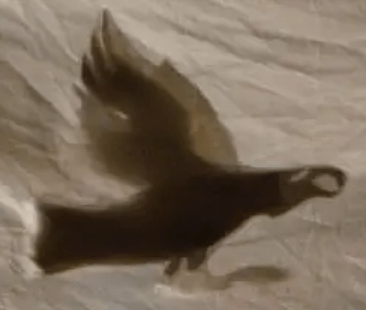
Sometimes I see things. Shapes lurking in the darkness, the shadow of an eagle swooping past the window glass of a high-rise tower. The other morning I swear I saw a panther climbing up the chain-link fence bordering the hillside cemetary. It was clambering straight up and paused for a moment at the top of the barrier to gaze at the sloped rows of tombstones and obelisks.
Or maybe it was just a black cat and I was having a Poe-esque hallucination of scale, imagining a monstrous sphinx in the distance when faced with a mere insect positioned just inches away. It’s possible. The dazzling morning light is known for playing tricks on the eye.
My visions are infrequent and mostly of a non-disturbing nature. They succumb to rational explanations that often reveal them to be the most commonplace of sightings, hardly visions at all. The only extraordinary thing about them is really just my own excitement and surprise around the experience. My own subjectivity embellishes an otherwise ordinary sighting with the aura of mystery, the uncanny. In other words, I have an overactive, and perhaps self-congratulatory, imagination.
I’m hardly a real clairvoyant, not like the woman I would regularly see at the grocery store in pre-pandemic days. She was struck by visions every few minutes it seemed, so much so that these sightings had long ceased to be events of wonder and represented instead a lifelong obligation, an almost ethical responsibility to look carefully at and bear witness to whatever it was that hung suspended in the air approximately three yards in front of her and caused her to stop in her tracks so abruptly, shopping cart grinding to a halt in her grip. It would take her around fifteen minutes to get from the entrance of the store to the start of the aisles, as her attention was arrested at every other step and she stopped to squint and stare, with equal parts fascination and alarm, at the picture taking shape before her.
This woman appeared to be highly sensitive and perceptive in a lot of other ways too. She wore long cotton gloves at all times, even in the heat of summer, and her arms and ankles were always swaddled in a white, sock-like fabric. I thought she might be sun-sensitive or suffering from an auto-immune condition, or both. She had befriended one of the grocery store employees, a younger woman who always wore a gauzy, all-black, goth-like outfit and had a distinct air of delicacy and sensitivity herself. I would find them in the pickles aisle chattering happily away in their highly feminine, birdlike language, the older woman exuding a light, maternal warmth that was always cheerful and generous, never cloying. The younger woman looked buoyant and nourished during these encounters; I’m not sure if she knew many people who she could talk to in quite this way, who could talk to her in quite this way.
One evening this woman, this seer, approached me as I was seated at one of the tables outside the storefront, gobbling up my dinner. She saw something in me that she wanted to speak to, perhaps connect to. She asked if I had asked to have my dinner heated up behind the deli counter, as it was a cold night and it was never nice to eat cold food on a cold night. I said that I had, my dinner was still hot. She remarked that it had been a long time since she’d last seen me at this store. I had just had a rotten day and I was now eating my dinner in the cold in a rotten mood, hunkered over my food somewhat like a wounded animal. Was this what she saw in me? It is the mark of a cowardly, undeveloped soul when one feels like fleeing from sight. I said something curt, brusque, finished the last bite of my meal, and stood up to go. She looked stunned and withdrew. Our nascent connection was broken, I had broken it with my savage fear, and I have regretted it ever since.
———-
There is another kind of vision I experience from time to time that does feel uncanny and inexplicable. Every now and then, I’ll be going about my usual business, not focussed on anything in particular, when the thought of someone I know will suddenly pop into my mind. It’s usually not anyone I know well or have even interacted with at all for some time. It’s not anyone I’m in the habit of thinking about at all, for that matter. And in fact, to say that I know the person is usually an overstatement; it would be more accurate to say that I know of the person, that is, I merely know their name. So it will strike me as a bit odd and out of the blue to suddenly think of this person, and I won’t understand why until several days, perhaps a week later, when some email announcement gets circulated or I happen across some news online that informs me, in effect, that the person I was thinking of has just published a new book.
I’ve wondered here, too, if there’s some rational explanation behind these occurrences. I’ve wondered if I did already see the news but somehow forgot about it or stuffed it away, and so my sudden thought of the person is actually a form of unconscious remembering. I’ve wondered how this might be connected to the convention of situating fictional narration in the past tense. What you are about to read has already happened, even though your discovery of the full story has yet to occur. What you are about to read is already old news for the narrator. Can one be both the narrator and reader of one’s own experiences? In that case, one is always a little bit ahead or behind oneself in the scale of time, depending on the perspective one happens to assume. The convention of past-tense narration presumes a certain fait accompli: the narrator already knows, and is now performing the formality of revealing, unreeling the story like a deck of cards shown one card at a time, with expert timing. The narrator is like that clever detective at the end of a British mystery novel, the one putting the pieces of the puzzle in order with a confidence and rationality that’s almost annoying.
What if the narrator doesn’t have all the answers up front? What if the narrator is just as much in the dark as the reader, and is newly discovering each new segment of the narrative as it’s being told, is narrating in effect like a reader? Perhaps then we are in the breathless, present-tense space of the truly experimental novel, where the narrator has no master plan, no blueprint, no driving intent to push the story in any particular direction, other than the primal drive to write, the primal drive to narrate. Is this a case of the writer taking a passive seat at the table, submitting to the wild field of the page with its unknown events and experiences? The writer consenting to be inscribed by the action of the story itself? It’s exhilarating and terrifying to be the one written on, as Kafka can tell us. If not more so to be a witness to such an event. So, reader and narrator in the space of the true fictional experiment, linked in a passive conspiracy of documentary and spectatorship, flying into the unknown page. This year, abdication of intention and control. Next year, Marienbad.
I’m not an experimental writer in that sense. I almost always know where I want to go, I have goals in mind of a certain endpoint and certain key signposts along the way, that I want the narrative to hit. What I don’t know is how to get there, how to even find the winding path that goes there, much less follow it. Finding and forging this path is the problem of the story; straying from the path once it’s found is the heart of the story. So I suppose mine is the hybrid approach of a skeletal framework of points of telos with many coats of digression piled onto it. Telos is the goal, the purpose. Digression is the warmth, the picaresque, the comedy of the journey which is the condition of perpetually losing one’s way and finding it again, which is the condition of human existence. Cervantes had the right idea along these lines. I like Cervantes.
Where in the world was I going with all this? My uncanny visions of publication by people I mostly know only by reputation. Could these chance occurrences be explained away as stray fragments of information encountered peripherally in passing, then tucked away in half-awareness and forgotten, surfacing later at some ambient moment when my brain is humming through one of its maintenance cycles? No. In all cases, I have not been reading newsletters or blogs or announcements or online boards that typically publicize such matters, nor have I been in conversation with anyone discussing anything even remotely connected to such matters. I can only conclude that I am seeing publication at these times, and specifically that I am seeing that moment when the book or published work leaves the author’s hands and enters the domain of the public. For what other reason would I be struck with these momentary flashes of names lighting up the dim air? It’s like when you move through the cluttered darkness and a stray particle of dark matter comes out and attaches itself to you. It is impossible to ignore such a seemingly trivial yet nagging presence.
I’m not saying I’m psychic, but the other day appropos of nothing, a certain writer suddenly came to mind while I was riding the bus to work. This particular transit agency had once hosted a community project where it published short poems on the high interior walls of its busses, right above the windows. I was approaching my stop, staring at this space on the bus where the poetry used to be, thinking idly about this fleeting and embedded way of flash-circulating art in the world, and suddenly the name of this writer, who is a poet, jumped to mind. I have never met this writer, we are not in the same or even similar circles of aesthetic affinity, and I had not thought about her in years. A long time ago, she’d contacted me by email to see if I had any work for a project she was curating. I didn’t have new work at the time so I didn’t become a part of the project. Later, when the project went public, this writer got a lot of blowback and flack for it in a way that to my mind, in retrospect, seemed unfair. Aside from a few valid criticisms regarding how the project was framed, it seemed that she came under attack mostly for having tackled the project as an outsider, without having jumped through the requisite hoops of an insider and without having consulted the insider community for its guidance and approval. Worst of all, she had initiated and carried the entire project through to completion without even becoming aware that there was an insider community at all to court and tiptoe around deferentially, which is of course the most damning and offensive mark of the outsider, at least from the perspective of some insiders.
I noted the memory, randomly and oddly injected into my thoughts. The bus pulled to a stop. I got off, walked the last 150 yards to work, and thought no more about poems on busses and poets I’ve never met.
Three days later I’m in a teahouse getting a pricey drink. It’s one of those high-end places that crafts its own artisan tea blends sourced from ethically responsible plantations in the developing world. The tea is delicious and the place is very popular with students as there is a college campus close by. I often wonder how they are able to afford the prices here. I’m at the counter paying for my drink when a small display placard catches my eye. “Limited Edition Craft Poetry Blend” it says, followed by three or four names. One of them is my randomly remembered writer from the bus ride. The placard talks about how these limited edition verses are steeped in the complex flavors and aromas of the season, and how they are best savored by the fire with a freshly brewed cup of tea in hand, one specialty tea blend paired with each featured poem/poet. I feel very strange, like the subject or target of a cosmic joke, which is also not an entirely unfamiliar or unpleasant feeling. Everything in my existence eventually becomes all right for me, once I locate the comedy in it, which is often tied up with the poignancy of it. Though I wonder sometimes if I lean a bit too much on this comedy muscle of mine. Where can I find these poems, I ask the cashier, can I read them for free? He doesn’t know, the placard campaign just went up that morning, he doesn’t know anything about it. Are the poems printed on the tea packaging, I persist, like in the Chipotle essay series? Or are they on the tea bags themselves? The cashier shrugs to get rid of me and mentions the tea company’s website, where I learn that the poems are printed on collectible cards, a quartet of handsome, invitation-sized cards to accompany the quartet of specialty loose-leaf tea blends that can be attained as a packaged set for a modest price. With the money I save by taking transit, I should be able to afford the set by the end of the season.
 DARK LITERATURE