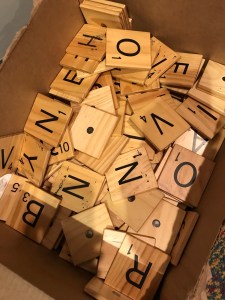
Here in the office this weekend catching up on a deadline. In the game room, someone has composed the following poem, spelled out in oversized magnetic tiles on the Scrabble board. Reading the horizontal lines top to bottom, then the vertical ones left to right:
LEGALIZE ACCESS CODIFY ABORTION SAFE REPRODUCTIVE
TIME CHOICE PRO RIGHTS FREE ROE JUST DREAM
Or in waterfall formation, following the flow of intersections:
TIME LEGALIZE ACCESS CODIFY PRO ABORTION CHOICE SAFE FREE REPRODUCTIVE RIGHTS ROE JUST DREAM
I seem to have been called into service again. How did this happen? Seems like that other writer (that other “I”) has seen the light of freedom and that light sparks in a glow just above my left shoulder as I launch out to orbit again, to send myself out again into the dark matter of inner & outer space. Can you sense my utter lightness of being, my ineffable subatomic gravitas?
To quote Rachel Carson (thanks to the elucidation of the inestimable Maria Popova whose hardback edition with its jacket cover of Springer-Verlag yellow has been traveling in my book bag for weeks):
… the writer must never attempt to impose himself upon his subject. He must not try to mold it according to what he believes his readers or editors want to read. His initial task is to know his subject intimately, to understand its every aspect, to let it fill his mind. Then at some turning point the subject takes command and the true act of creation begins. What results is a mysterious blend of writer and subject. Given the same subject and two writers the results will of course be different, just as the theme of a symphony falls upon our ears differently when stated by the strings or by the woodwinds. But as the theme is more important than the instruments, so in writing what is said is more important than the writer who says it. The discipline of the writer is to learn to be still and listen to what his subject has to tell him. Those who have experienced such unity with great universal truths know that a writer’s role in expressing them is privileged and rich in satisfactions.
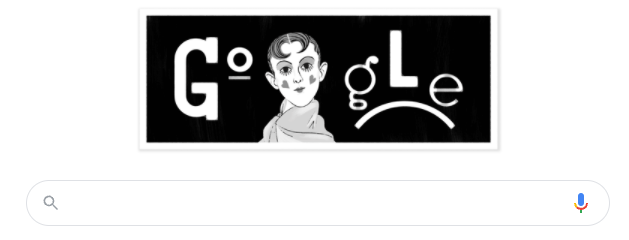
In writing what is said is more important than the writer who says it. Rimbaud wanted to make himself a poet, but even more important, to make himself an instrument for poetry. At some point, Rimbaud the person stopped being a poet and became a trader instead. Rimbaud the instrument continues to sing through the ages.
I want to be an instrument, if not for poetry, then for a certain genre of freedom that travels through writing, for particles of thought & feeling that travel close to the speed of light. I want to be an instrument, J.S. Bach’s solo organ/harpsichord in Brandenburg 5, the punk-rock strings in the opening bars of Beethoven’s 5th. An instrument that is also a spaceship.
That other writer will start transferring all the copyrights for their posts to me, effective immediately. This is the most sensible approach to take, for all of us concerned. My colleague The Reader reminds me that time is limited, that readers cannot afford to waste their time on texts that haven’t yet been proven. Which to The Reader means that he spends the vast majority of his time reading work by dead authors, the authority & significance of their works being proven some decades or centuries after their mortal passing. So I will write for the living, the dead, and the ones not yet alive.
I wish to be speedy, yet also patient.
Writing is an asynchronous act. Reading is a form of space-time travel. I’m searching for the information that might or might not escape from a black hole.




 DARK LITERATURE