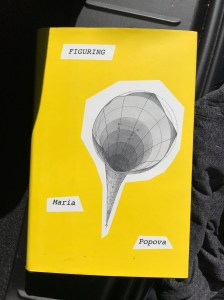
As a former aspiring astronomer, former sub-mathematics student, and ex-pseudo-poet, I might be the target niche audience for this book, so sunny & erudite & yellow like a delicious title from the iconic Springer-Verlag library. But actually this book was written for everyone, everyone and anyone that is, who has ever felt the thrillingly romantic, 19th-century or fin-de-siecle “vibrations of the soul” in the presence of celestial or aesthetic beauty, or in companionship with a kindred human spirit.
I first learned of the existence of the writer Maria Popova in a Zoom chat window in the midst of the pandemic shutdown. I had enrolled in an online course on emotional intelligence taught by a CBT therapist/writer, and during a large group session on managing one’s feelings around destructive negative self-talk I contributed a reference to Dostoevsky, to the dysfunctional yet irresistably attractive Dostoevskian universe of monomaniacal monologues & obsessions, how hard it is to let go or even set aside such psychological orientations when they have become so intertwined with one’s intrinsic identity as an artist & thinker. In response to this contribution a classmate private-messaged me in the chat expressing validation & resonance: she too felt this deep emotional, psychological, intellectual affinity with the Dostoevskian universe even though she recognized it too as a source of her suffering, a suffering that she was still loath to shed lest she should discover, in the absence of the pain & suffering in her heart, an even more dreadful & devastating emptiness. I realized that this classmate was the same person who had taken to posting poems by Rumi and others in the collaborative online community space attached to the course. She had enrolled in the course as part of her healing from the traumatic break-up of a significant relationship, a relationship, I was given to understand, that had also produced a child. All of this she revealed to me in a few words, in the hasty, abbreviated dialect of instant messaging and sudden confessional intimacy between strangers before they withdraw again into their respective corners of brooding introversion. And into this chiaroscuro darkness she also tossed a few splashes of light: one of these was a link to Popova’s website, then known as Brain Pickings, now The Marginalian.
The site is like a one-woman literary salon, assiduously erudite yet solidly accessible, an often breathless expression of Liberal Humanism 2.0, rebooting the idea that art & lterature are nourishing for the soul, even in a post-postmodern world. I can see how my suffering classmate found comfort in it. Fast-forward a few years later, and I am in an amazing indie bookstore in a college town in the Pacific Northwest when I see the hardback edition of Figuring prominently displayed on a front table. I snap it up despite its hefty weight, knowing that I’ll be risking an overage fee from my airline carrier by packing it in my checked bag and having it tip the scales past the 50-pound limit.
“Figuring” is used in several senses here. There’s the mathematical, analytical sense of working out numerical figures, as in Maria Mitchell’s and Caroline Hershel’s meticulous astronomical calculations – these two female scientists serving as historic and symbolic gravitional centers for the book to revolve around. Then there’s the painterly, aesthetic sense of human figures in the foreground of a vast cosmic panorama: figuring here is the act of sketching and delineating the outlines of these mysterious characters.
Popova plays the role of biographer in a deeply associative universe of poets, artists, journalists, astronomers, mathematicians, and thought leaders, mostly of the 19th century Transcendentalist Boston brahmin set (social/intellectual circles of Hawthorne and Thoreau and Margaret Fuller) and Amherst set (the Dickinsons). One of my correspondents complains that the second sense of “figuring” is overly privileged over the first, and it is true that the book sometimes reads like a highbrow gossip mag as if written by Anne of Green Gables. The focus, for example, is more on Maria Mitchell’s romantic passions than the mental details of her scientific works.
But I’m interested in Popova’s interest in the (often epistolary) love lives of old-fashioned, ostensibly buttoned-up intellectuals, precisely because it explores queerness in a way that cuts against the trendy grain of sex-positive third-wave feminism and performative queer theory. Maybe the sex-positivity and queer-positivity of fourth-wave feminism can be exactly about this kind of recuperation of the erotic as an expansive, inclusive expression of sensual affect that encompasses physical, emotional, and intellectual attraction alike. It’s worth reconsidering how James’s The Bostonians can be seen as super hot, and what poets in long dresses can teach us about having torrid affairs of the heart with the aid of 19th century social media.

 DARK LITERATURE